
Challenge
Appalachia
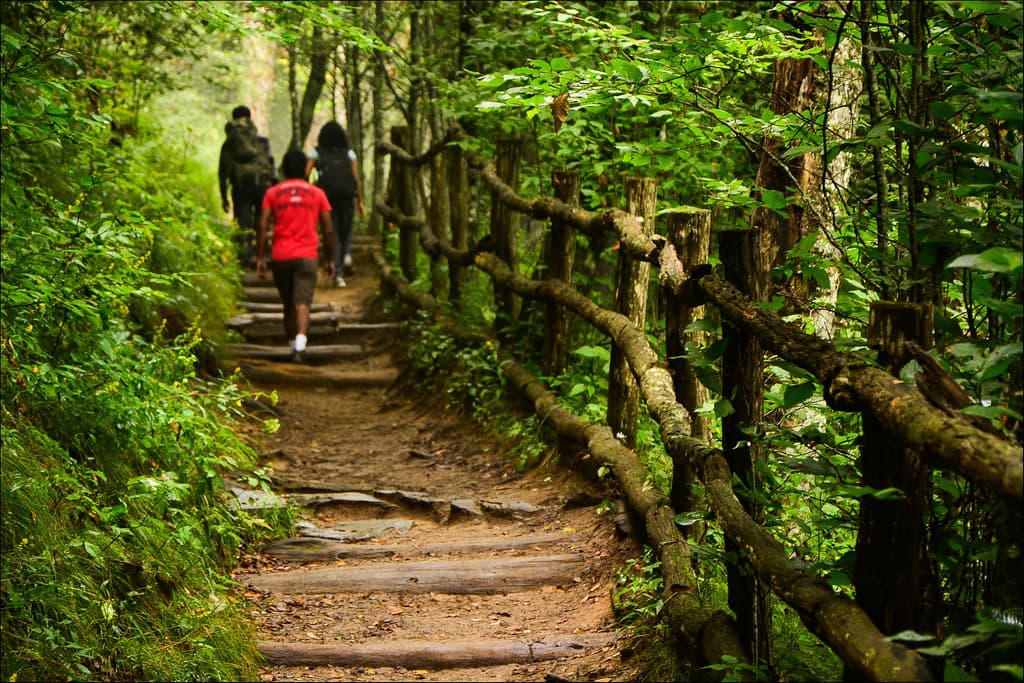
The Appalachian Trail, or A.T., is not simply a long path through the eastern mountains of the United States. It’s a living journey of transformation. Stretching from Georgia to Maine, this sacred route invites walkers into the slow rhythm of the earth. Here, each step becomes a meditation and each day a quiet conversation with the forest.
General info
<p>The Appalachian Trail was imagined in the 1920s as a “footpath for those who seek fellowship with the wilderness.” Stretching from Georgia to Maine, it was built by volunteers, dreamers, and lovers of the land who believed that walking could be a form of healing. Today, it remains one of the most beloved long-distance walking routes in the world. It’s a pilgrimage of presence — not a race to reach an end, but a continuous unfolding of who you are becoming along the way.</p><p>One moment you walk beneath a cathedral of green leaves, the next you stand above a sea of clouds. The Appalachian Trail connects national parks, wildflower meadows, and small mountain towns where the warmth of human kindness is still present. Born from the vision of Benton MacKaye in the 1920s, the Appalachian Trail was imagined as a footpath for those seeking renewal and connection. Today, it remains one of the world’s most beloved long-distance walking routes, a place where walking becomes prayer and time becomes teacher.</p>
How to hike the Appalachian trail?
<p>You carry only what you need — and soon, you learn that what you need is far less than what you thought. Every day becomes a return to balance, to humility, to gratitude for the smallest comforts: dry socks, a kind word, sunlight breaking through the trees.</p><p>You need only what helps you stay steady and free. A sturdy pair of boots, a weatherproof layer, a well-fitting pack, and a simple shelter are enough. Many carry a journal to record reflections or a stone from home to lay down later, as a quiet offering. The lighter the pack, the easier the becoming. The A.T., as walkers lovingly call it, is well-marked by its white blazes and cared for by a wide community of volunteers. It is a safe and welcoming path, though awareness remains your best companion.</p><p>This is a journey best taken slowly, across weeks, seasons, or even years. Some walk sections each year, returning like the tide to the same familiar ridges. Others stay for months, letting the trail reshape them in its own time. There is no clock, no measure, no competition.</p>
Where to go on the Appalachian trail?
<p>The Appalachian Trail offers a kind of simplicity that modern life often forgets. Along the way, you sleep in rustic shelters or under the stars, eat simple meals cooked on small stoves, and draw water from clear mountain springs.</p><p>Along the Appalachian Trail, shelter is part of the rhythm of the walk. Simple wooden huts, lean-tos, and campsites are spaced every few miles, each offering a roof, a place to rest, and a quiet moment under the stars. Some walkers pitch tents or hammocks between trees, others stay in nearby hostels or lodges when the trail passes through mountain towns. </p><p>Water flows freely through the mountains; springs, creeks, and shelters often have sources nearby. Wildlife, too, asks for respect: store food properly, move gently, and remember that this is shared ground. Over time, the A.T. reminds you that transformation doesn’t happen by striving but by listening: to your breath, to the rain on leaves, to the pulse of the living world.</p>
Distance
2200 miles
Avg Completion
5-7 months
Best Season
Summer, Spring, Fall